|
|||||||||||||||||||||||||||||||||||||||||||||||||||||||||||||||||||||
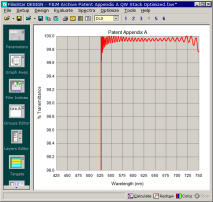 Main Screen
|
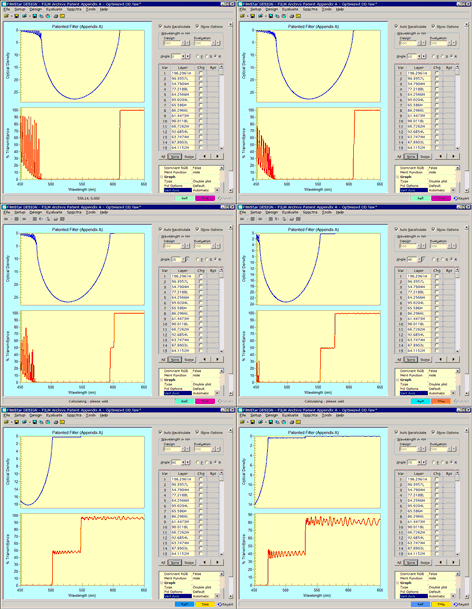
Thin Film DesignVirtually any number of repeated layer groups (fast calculation algorithm) and separate layers. Optical, physical and massive layer thicknesses. Rugates, mathematical operations, Herpin replacement, optical to physical thickness conversion, groups to layers conversion, reverse design, inhomogeneous layer simulation, tooling factors, very thick layers, math functions, etc. Design macros with angle and wavelength matching, combines designs into assemblies. Sub-designs can be loaded from disk, edited, matched and combined into a single design. Supplementing Layers Mode and Groups Mode design editors, the Stack Mode editor provides special features for film constructions involving many materials. One could, for example, have a design with 32K layers and materials. The DESIGN Interactor provides an alternative front end which makes it easy to visualize multiple spectra. For example, P and S polarization in reflectance, transmittance, absorptance, etc. can all be visualized. Layer thickness, angle, etc. can be varied via keyboard or mouse. A CIE color window is supplemented by RGB color boxes. The Interactor is included in the Free Version! Most importantly, measured spectra can be compared with designs. The importance of visualization cannot be neglected! If a design is fabricated with extra quarter waves (as happens in production), it will be obvious by visual inspection. In such cases, automatic solutions may be useless! The Interactor lets users automate specialized calculations in FilmStar DESIGN (using FilmStar BASIC), in Excel, or in user-applications such as our Admittance Smith Chart example. |
||||||||||||||||||||||||||||||||||||||||||||||||||||||||||||||||||||
 Built-in Index Functions
|
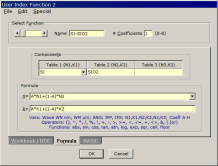
Film IndicesFilm indices can be defines as constants (for initial designs), look-up tables, and functions of wavelength with 7 or more coefficients. Index values are created and maintained in FilmStar INDEX. Built-in functions include Buchdahl, Cauchy, Lorentz, Sellmeier, F-B, Tauc-Lorentz, GaAlAs (Afromowitz), etc. To simplify matters, users can check which functions appear in the Film Indices dialog. Advanced users may define their own functions in an equation editor, in the FilmStar Workbook, in Microsoft Excel, etc. These functions act as if built into DESIGN and INDEX. Using inverse synthesis, coefficients may be determined from measured spectral data. In addition, built-in mixed material models include Maxwell-Garnett and Bruggeman. User-defined functions may include up to three look-up (n,k vs. wavelength) tables. Indices varying with film thickness are supported in Stack Mode. Outside of applications such as aluminized mirrors or dichroic art-glass (artists prefer that no two coatings match), understanding refractive index variations is essential. A recent Interactor update supports index variations. Users can, for example, visualize the spectral differences between 'good' and 'bad' TiO2 as in Index Variations (My Tio2). |
||||||||||||||||||||||||||||||||||||||||||||||||||||||||||||||||||||
|
|
Multiple SubstratesSubstrates can be treated as massive layers; this allows evaluation and optimization in complex systems containing multiple absorbing substrates and air spacers with films on all surfaces. Massive layers make it possible to optimize coatings for forward and reverse light incidence. A typical application is architectural windows. Click here for further information. |
||||||||||||||||||||||||||||||||||||||||||||||||||||||||||||||||||||
Program CapabilitiesCalculated Quantities - [%R, %T, OD, phase] vs. [wavelength (nm, microns, Angstroms, 1/cm), angle or thickness]. Other modes: electric field, total/partial (in specified layers)/differential absorptance, CIE color, ellipsometry, Herpin indices, contour graph, group delay (GD), group delay dispersion (GDD), chromatic dispersion coefficient (CDC). Spectral data is stored in .csv (comma separated values), .dx (J-CAMP 4.24) and .xls/.xlsx (Excel not required). GRAMS .spc files can be opened. The Collector saves multiple spectra in Excel format. Results can be transferred to other programs. Combinations of sources, filters and detectors are evaluated in the FilmStar Workbook. Optimization - Refinement using DLS, L-M, simplex, and gradient methods. Optimization variable linking , thickness and index limits supported. Targets at multiple wavelengths and angles include %R, %T, phase, ellipsometric Psi/Delta, reverse reflectance, GD, GDD and CDC. Targets can be generated over ranges of wavelengths and angles or imported. A CIE color module provides color optimization without having to specify any particular spectrum. Excellent results are often obtained with synthesis: the design of coatings where a starting design is not known. During optimization `needles' and other additional layers are inserted. Genetic algorithms support digital synthesis and refinement. In genetic synthesis, designs consisting of exact or near quarter waves offer alternatives to designs requiring thin layers. Additional methods include a flexible flip-flop synthesis algorithm as well as global search. |
|||||||||||||||||||||||||||||||||||||||||||||||||||||||||||||||||||||
|
|
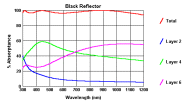
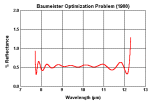
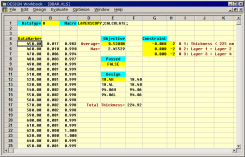
General Merit Functions and ConstraintsUsing FilmStar gradient methods it is not necessary to define traditional optimization targets. User-defined merit functions and constraints may be defined in FilmStar Workbook cells. This is extremely powerful and makes it possible for advanced coating scientists and engineers to optimize the conflicting requirements of architectural coatings, absorption in active layers, beamsplitter performance, etc. There is nothing comparable in other commercial optical thin film software.
|
||||||||||||||||||||||||||||||||||||||||||||||||||||||||||||||||||||
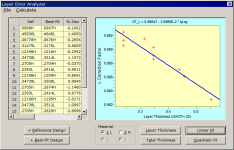 Layer Error Analyzer |
Reverse-Engineering (Inverse Synthesis)Designs are often well known. In many facilities the major use of 'design' software is in troubleshooting, not in designing new coatings. Spectra from FilmStar MEASURE and other sources can be converted into optimization targets. Starting with the theoretical design, the final design gives actual indices and thicknesses. Variables include layer thickness, dispersive index functions, and tooling factors. FilmStar includes methods for predicting the reliability of inverse synthesis. The Layer Error Analyzer provides means to understand systematic errors. This module generates correction functions for use in DESIGN, MONITOR and CRYSTAL. |
||||||||||||||||||||||||||||||||||||||||||||||||||||||||||||||||||||
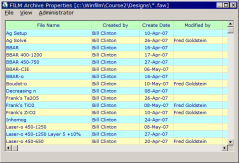 File Property List |
Managing Coating DesignsFilmStar supports NTFS file properties for managing designs and spectra. This is especially useful in facilities with multiple users. NTFS file properties are built into the operating system (starting with Windows NT) and are usually viewed by right-clicking a file name in Windows Explorer. File properties can be used for 'who designed it?' or ensuring that a user cannot overwrite another user's designs. Designs can be sorted and selected by file name, designer (My Designs), date, etc. Further management options are provided by the FilmStar Database. |
||||||||||||||||||||||||||||||||||||||||||||||||||||||||||||||||||||















Click here for further information on our support pages.